A record of an official CHV fact-finding trip to Vienna, by Philip Seddon
It has been a fascinating experience transcribing notes I have kept in my files from fifty years ago. Three pieces of correspondence provide the background to this visit:
- An air-mail letter to me from the Revd Bruce Duncan (11th June, 1969) informs me that I should try to arrive in Vienna from Tübingen (where I had been studying for the year) on 26th June; and that Bruce and I would both be staying at the Hotel-Pension Élite till 1st July. I do not have any independent records of my own dates of arrival and departure.
- A second letter (from F-D to Bruce, 24th June, 1969, on official CRI (Children’s Relief International) details some of the families we should meet to see whether we could offer any places to a selection of children from Caritas Vienna.
- A third letter from Bruce Duncan to me (21st July, 1969, also on official CRI paper) in my Tübingen Studentenwohnheim (student residence) expresses ‘our tremendous gratitude for the magnificent job you did in Vienna. Your full reports on your activities after I left you have been very useful indeed, and it is a great relief to me to know that what I set out to do in Vienna has been done – even though it was not me who did the work!’ However, of that final report, too, there is no trace, neither in my own nor in any extant CHV files.
In fact, it is only the photographs of the Patkolovs, and the various pieces of correspondence, that actually establish that the trip took place at all! I myself have only fragmentary recollections of it, though some photographic flashes of memory have re-surfaced now in compiling this report. The major one is the staggering contrast between our meeting with the aristocratic Countess Szapáry and the depressing quality of the buildings where most families lived. Were it not for the fact that it was Vienna, my major memory of enormous, gaunt, tall, frightening tower-blocks enclosing large central ‘quads’ would have made me think I was in some deprived part of East Germany or somewhere else in the Community block (see one or two related comments below).
In a few conversations it was difficult to know who was telling the truth, with various people speaking against what others had said (cf. especially Komlós and Nody/ Nagy below).
It is not always clear what meetings took place on what days; most meetings were dated, but some were not. ’n.d.’ indicates some uncertainty about precise days and times. I have omitted all telephone numbers from my notes as being now rather irrelevant …
Incidentally, some of my notes were written on the back of Peter Watson’s report on the 1967 St Peter camp – with yet another final discovery – today, 13th July, 2019 – linking Vienna to the Black Forest camps!
The Plan
Saturday, 28th June
- Ring up Diakonisches Werk/ Innere Mission (Sommerekker). – Unsuccessful.
- 11.00 The Eder family (re: Franz and Günter)
- 12.30 (Ring?/ meet?) Komlós: Address: Speckbachergasse 46/ 17, Vienna XVI
- 14.30 Visit the Patkolo family: four children might now be going – Josef, Sandór, Jenö & Roszi – or perhaps just Jenö or Roszi (F-D to Bruce, 24th June letter)
- 17.00 The Geiszbüchler family (in F-D’s letter, Geissbuckler)
Sunday, 29th June
- 12.30 Lunch with Gräfin László Szapáry (home: Dobersberg an der Thaya 47, Lower Austria.)
- Evening, perhaps: Komlós (or ring him Monday morning before 10 am)
Monday, 30th June
- Ring up Hertz and the Innere Mission to arrange pick-up of car at the Innere Mission
- 10.00 Peter & Siegfried Holly and family: Franz Hochedlingergaße 26/16, Vienna 1020
- 11.30 Marcel Faust of the (IRC) International Rescue Committee, at Graben 30/5
- Afternoon: Diakonisches Werk/ Innere Mission (again, unsuccessful)
- Car to be returned to Hertz Autovermietung, Rotenturmstraße 5-9, by 20.00 hrs.
- We need to have the room empty by mid-day; and to take everything with us.
- Contact Caritas: Monseigneur Unger, Währingergürtel 104, 1180 Vienna
- Try Komlós: Address as above (Speckbachergasse 46/ 17, Vienna XVI)
Introductory note: meeting with Monseigneur Unger of Caritas (Catholic Aid Organisation) (n.d.) (transferred from later)
Address: Währingergürtel 104, Vienna 1180
- Parents must repay the travel costs that Caritas has already paid out (200/ 300 Schillings). Caritas buys the tickets and insurance.
- The Definition of the word ‘Refugee’ (a political and anachronistic matter only)
- If one says one has fled because one is an ‘enemy of the State’, and hates that government because it opposes democracy, liberty and freedom, one is welcomed in a Western country with open arms and given right royal treatment.
- If, however, as usual, people just flee, and explain that they are looking for a job, they weren’t too happy at home, they want a new life, etc., they get nothing; because they have not defined themselves politically.
- So only thinkers and intellectuals have any chance of being real ‘Refugees’.
(Czech refugees in Vienna are given 200,000 Schillings!)
The meetings with the various families
Friday 27th (?) – or Saturday 28th June (but when?)
The Nody* family:
Address: Margarethestraße, 56/46
(*spelt thus on my notes. – I may or may not be right, but I wonder whether this was an old spelling of the Hungarian name that more commonly came to be spelt Nagy. I will use this latter form throughout.)
Frau Nagy is still not divorced; Ferry and László are both with her together. She is described as the ‘live-in companion’ (Lebensgefährtin) of Ferry Bartschy. She spoke Hungarian all the time. There are two rooms for all the children and friends – nine beds in all. There are nice paintings in all the rooms (her work – flowers, mainly; woodland scenes, etc.)
The family seems to be: Aniko, Gabi, Aggi, Zoltán, Kathi, Peter, Paul – and another two (1 & 3) elsewhere in Hungary? (Aniko is Canadian, and resident in Canada; Gabi lives in Vienna.)
- Frau Nagy and Zoltán. Frau N wants Zoltán to stay in England – or rather, she doesn’t specially want him back!
- But she understood that Aggi & Zoltán would be together in England. She says: they must be together.
- If they’ve got to come back, she wants them both: she will not allow any foster-parents to have Zoltán.
- But this is bad for both Aggie & Zoltán (and so, mainly, for Kathi).
- “Imagination! Lies! Martyr-complex! Fighter! Stern! Strong-willed!” (Is this me? Or Komlós?!)
Frau Nagy and Frau Plesik (the foster-mother of Peter, Paul and Kathi)
Frau Plesik’s home is bad; the mother ‘hits the kids; she is harsh and cruel to them …’
(This information comes from Marcel Faust.)
She hires the room; they all sleep in the one room – all four of them.
- ‘She also thinks that it is better for Zoltán to stay in England.
- ‘Frau Ricsováry is telling just as many lies as much as Frau Nagy. [But] she doesn’t have cancer.’ (This was the first time that K (?Komlós) had heard this attack.)
Saturday 28th June
11.00 The Eder family (re: Franz and Günter).
Address: Griegstraße 1-3/ 6/ 6, Vienna 1200.
(My notes include a tiny drawing of the building complex – 3 1/2 sides of a square tower-block, with maybe some trees in the middle, but the comment: ‘built 1951-2; like a prison’. That sense of a grim prison effect I do remember. )
The Caritas camps were ‘only’ three weeks long (Caritas camps are often for seven weeks (e.g. in Italy)). ‘Nothing for the girls’ – did they really not get any funding? Caritas paid 200 Schillings for the transport (or did they say 300?). They paid 1000s of Schillings for Franz to go to Italy.
There are three children in the family: Brigita (11), Herbert (c. 7), and Christian (10). Christian is at work earning money from 7.30 am to 7.30 pm – he is a very hard worker, so that she wants for nothing for her children. (Some confusion here.)
Earlier, they had lived 12 in a room; now it’s 2 1/2 rooms. – They are nice, lively children; their mother is very helpful and sensible. The father lives somewhere else; and is separated from the mother; he is sometimes in another family, sometimes at home. The children are quite enthusiastic in saying that their father doesn’t live there. The mother is a very hard worker. Everyone sleeps together in the same room. One boy is with foster-parents.
If Roszi (Patkolo) is possibly going to be able to come on camp, could Brigita be invited too? (It depends on the numbers and allowances, and on the numbers of student leaders.)
12.30 Meeting – or phone call – with Komlós:
Address: Speckbachergasse 46/ 17, Vienna XVI
‘Don’t believe anything she says!’ e.g.
- Earlier she had said that Komlós kept all the money he got to himself – when he had given her 16,000 out of 32,000 Schillings. [László Bartschy is her lover; but Ferry Bartschy is the one she’s supposed to be going to marry.]
- She doesn’t/ didn’t do anything for the children (??cf./ ctr. Zoltán and the Wiener Knabenchor (Viennese Boys’ Choir))
14.30 The Patkolo family
Address: Trappelgaße 8/ 32
Jenö and Roszi can take part: that would make four of them, including Josef and Sándor.
Children: Roszi, 11; Jenö, 9; Kati (?5). (’Partners in tennis matches’ – meaning no longer clear!)
Jenö failed his German Language exams. So either Jenö or Roszi. Somebody has to stay behind to look after Kati. In any case, two more invitations are needed for Roszi and Jenö.
Mrs Patkolo was divorced 18 months/ two years ago.
Remarks from teachers indicate generally how well she looks after her children (and their clothes), now that her husband can’t waste any more money.
(Further conversation in Hungarian.)
Would Roszi be the only girl? (The eldest daughter lives in Hungary with her grand-mother – a child of the first marriage.)
17.00 hrs: The Geiszbüchler family
Address: Frömmlgaße 3/ 9/ 4, Vienna 1210 (house built 1960-1)
July is not possible ; only August.
Children are: Franz, Heinrich, a girl of 14 (Veronika Dusek), and two younger ones. (Is there any possibility of Veronica coming?) Is Heinrich definite?
The father works in the car/ welding industry (Gasschmelzschweißer: gas fusion welding).
I noted: ‘we were offered a cup of coffee here’ …
Sunday, 29th June: Lunch with Gräfin László Szapáry
Discussion with the Gräfin* (see Concluding Unexpected Postscript at end)
‘For heaven’s sake, look at me!’
(I cannot recall whether that meant: ‘Look at these terribly reduced circumstances in which I now live’; or, ‘Look at this wealthy apartment that I am lucky enough to live in!’)
There are three children:
Christina (Tina, 12): Nikolaus (Nicky, 10): Peter (Putsi/ Petsi, 5)
Her husband László is a distant descendant of the 19th-century Austro-Hungarian General who was Franz-Josef’s Field-Marshal (there is a portrait of him in the room to the left). He had three children:
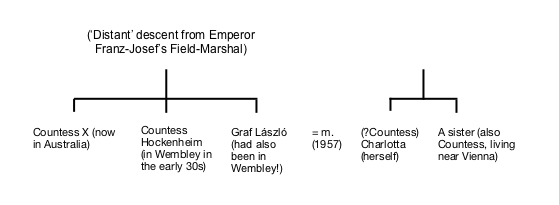
a) Gräfin Charlotte’s narrative of László Graf Szapáry (Ladislaus (László) Peter Maria Gabriel Antonius Benedikt Bonaventura Graf Szápáry de Muraszombath, Széchysziget et Szapár), born 12 July, 1910, and died (I just discovered) on July 22, 1998, at the age of 88.
He is Hungarian, a descendant of the general who fought in the Austro-Hungarian wars; that correspondence (e.g. with his wife) can be read in French in the archives. There is a portrait of him and his wife in the lounge; also one of Emperor Franz-Josef; and also one of this same Franz-Josef’s Field-Marshal’s grand funeral.
His father set all the children on to sport when their mother suddenly died (of TB?) – skiing, tennis, riding, shooting, etc. He was afraid they would get it (TB) too. Doctors hadn’t saved her life. ?Likewise, the Countess’ hip [problems] remain, and she too will have nothing to do with doctors.
The original Szapáry castle, now owned by the Dobersberg City Council, dates from the 16th century. Graf László was given it shortly before he married Charlotte (an uncle was looking around for someone in the family to give it to!). The forests and the land are now co-owned by the Graf/Dobersberg estates. Their money now comes from old Czechoslovak-Hungarian estates (?like Komlós’).
László is a great shooter: there are vast deer horns in the entrance – he shot ?43, but these are the only relics from the home estates.
The castle was ransacked by the Russians (1914?/ 1944?): the pictures were all scorched; but were recovered and saved (by Charlotte, I think) – but when?! Now it has all been re-done and completely restored.
b) Narrative of Charlotta Gräfin Szapáry (Wilhelmina Elisabeth Charlotta Star Busmann), born 7 March, 1932, who (I also just discovered) died on 8th February 2012, aged 80 (see below).
She went to school in South Africa, where her father was an Ambassador, having also been an Ambassador in Moscow. He is now at the Embassy in Cairo (I wasn’t clear whether he was the Ambassador for Czechoslovakia, or Austria or Hungary!).
She travelled to Cairo, to the Ussuri River area (the far-eastern border between Russia and China), to Moscow; she attended two receptions for the Algerian President Ahmed Ben Bella and the Russian statesman Alexei Kosygin, and met (?Rodion) Malinovsky. (A newspaper reporter asked her, ‘What were you talking about? No one has ever spoken so long with him before!’)
‘People come and people go’ (Khrushchev had also meanwhile been deposed …!).
The boys Nicky (= Nikolaus) and Peter are in Cambridge … (Is that part of the connection with CHV?)
Border issues.
The border is a mere 10 km away; there is an electric fence; and ‘one comrade’ (patrolling, presumably; who takes Sunday off). A small three-yard-wide track forms the visible boundary. If you go beyond – ‘Achtung! Staatsgrenze!’ (‘Watch out! National boundary!’).
(Not that that stopped Lászlo from shooting some huge roebuck just across the border-stream nr (?) Kleine Taxen at night …!) – The villagers of Kleine Taxen think she’s got a border complex: she always takes visitors there, and often goes in a mini-skirt to excite the ‘Herren Comrades’!
She is an Anglican; he a Catholic. The children are therefore Catholic. Anita (Christina/ Tina) was at St Ursula’s ‘boarding school’ in Vienna, while the boys are in Cambridge …
For ‘going out’ (!) she regularly wears red boots, black cords or jeans, a white skin-hugging sweater, a huge black cape, and a black Austrian (hunting?) hat with feather.
Monday 30th June
10.00 The Holly family (re Peter & Siegfried):
Address: Franz Hochedlingergaße 26/16, Vienna 1020
There is one large, old, dirty yellow back-yard. Walls crumbling, tiles from the mid-19th/ century (this was one aspect of my scant memories of Vienna).
(Link via Caritas.) The mother had been in hospital; the daughter (c. 11 yrs. old) Annette was going to the Austrian camp for four weeks in July (?!). There were also two boys.
They have two houses – they have lived here for years. Probably the other house belongs to a relative.
(as per the written report): The mother had been sick and had to go to hospital.
The children cannot not be taken, although they seem to be well looked after. Siegfried (e.g.) was wearing a nice shirt and trousers. He seemed to be a nice, calm lad; the mother was very friendly.
11.30 Marcel Faust (International Rescue Committee):
Address: Graben 30/5.
Only a very brief conversation, perhaps half-an-hour, at most.
Nagy: would it be possible for other families to go?
Ricsováry? (i.e. who is she? Where does she fit in?)
‘That’s a bit optimistic; and it would require a lot of money in order to have “our man in Salzburg”’.
The work of the camps is very praiseworthy (lobenswert)!
Action points:
Invitation letters need to be sent to Caritas from Cambridge fast (!) for Peter & Siegfried Holly, Franz and Günther Eder, Birgita (?), Heinrich Geiszbüchler, and ?Veronika (Dusek)
Concluding Unexpected Postscripts
1. I have just seen today – Sunday, 7th July, 2019 – a notice of the death of Charlotte Gräfin Szapary in 2012:
‘Charlotte Gräfin Szapary (née Star Busmann) died in Vienna on 8th February 2012. The funeral will take place in Dobersberg, Austria on 15th February at 2 pm. A Service of Thanksgiving will be held at Christ Church, Vienna, on 16th February at 6 pm.’
(https://groups.google.com/forum/#!topic/peerage-news/xKBCgB9sT-g)
The home address in Vienna, the funeral in Dobersberg (the ancestral home), and the link with the Anglican Church in Vienna, Christ Church (she was an Anglican), all fit. She would have been 80.
In the on-line discussion following this announcement, there are two relevant statements:
‘She was born in Utrecht 7 Mar 1932. She married 1957 Ladislaus (László) Peter
Maria Gabriel Antonius Benedikt Bonaventura Graf Szápáry (Altmünster 12
Jul 1910 – Dobersberg 22 Jul 1998). They had two sons and a daughter.’
’She was the granddaughter-in-law of Fürst Alfred zu Windisch-Grätz (1851-1927).’
The line of the (zu) Windisch-Grätz family certainly included a 19th-century Field-Marshal in amongst the many Counts and Princes of seven centuries of history, but I was not able to find the particular Fürst/ Field-Marshal cited; but since she herself came from a long line of aristocratic – and indeed regal – European families, such seemingly ‘distant’ political, military and high-born links remain extremely important, her maternal line going back 1,000 years, and her paternal line (Busmann) going back to the 1530s and perhaps also the 1100s (cf the web-site ref. above).
It is astonishing that, with such a lineage, the Gräfin should have taken such an interest in the CHV camps, whether through involvement with CRI (Children’s Relief International), or through her own personal links with either Komlós or Marcel Faust of the International Rescue Committee. What is clear is her documented work (see below) in selecting the children for the camps through Caritas and Monseigneur Unger, Diakonisches Werk and the Innere Mission. Was this a case of noblesse oblige? Or perhaps she was also a major benefactor of the work of the various refugee organisations and of CHV? Perhaps F-D, with his inimitable gifts of making intriguing and vital contacts, was the only person who knew the full inside story of her involvement … Whatever – she was a most imposing, engaged and engaging figure!
2. By complete contrast, it would be fascinating to know what happened to some of the leading ‘campers’ who went on to be part of the later CHV leadership teams: Witold Kalinowski, Eleonora Pal, Victoria Pietraszek. – Whereas one can quickly discover, via google, all sorts of information about historical aristocratic families, it would not be so easy to trace the subsequent lives of the rather more ordinary children of the refugee families of DPs (Displaced Persons) for whom we were so pleased to be able to offer the relief of summer camps in the Black Forest …
It seems a rather serendipitous conclusion to this report to reflect on the very different lives of those I met on my Vienna trip, and those we entertained on the CHV children’s camps. But it also seems a fitting, if ironic, conclusion to this report, transcribed these fifty years after the events described, that it was possible to find out about the death of Charlotta/ Charlotte Gräfin Szapáry, to whom, in some mysterious ways, CHV/ CRI clearly owed such a great deal. The collation of all the CHV materials, then, in its own way, with the publication of the hard copy of the details of so many years, and the closing of the CHV archives, offers its own parallels to ‘the closing of the book’ of the lives of Charlotta/ Charlotte Gräfin Szapáry (d. 2012) and László Graf Szapáry (d. 1998).
3. Further, and despite working on this material for quite some time now, I have only just noticed two final touching (and previously forgotten) details in Peter Watson’s report (2nd October, 1967) of the Black Forest camp in St Peter that he led that year, which brings together the lives of Gräfin Sazpáry and the St Peter camp in a wonderful way.
- On the ‘front cover’ of the report, with names of student leaders, etc. (‘Black Forest I, 1967’), he writes that ‘Fourteen boys and twelve girls [were] chosen by Caritas’, which it is now clear is the organisation that the Countess was most closely linked with.
- Secondly, he reports (p. 1, para. 4) that ’[t]he climax [of the camp] came on the second Sunday afternoon when the children gave their concert. Perhaps the audience was not as big as we had hoped, but Countess Szapáry, who selects the children (my italics), some local farmers and the Edinburgh students found the children’s efforts to be of an extraordinarily high standard, considering that most of them had never been encouraged to sing before and the short period of practice available to them’. It is very moving to be reminded that the Countess herself, in person, visited the camps in the Black Forest. That was the degree of her commitment to the work.
4. This is finally underlined, with further important supporting observations, by two paragraphs from the (CRI) Children’s Relief International Review for 1967 (in the files):
- ‘Countess Szapary, of Caritas, who selects most of the children for our Black Forest camps, says that sheer poverty is at the root of much of the trouble. In many cases where this is not the basic cause, children often have one or both parents with severe psychological disturbances (PJS: to which I can certainly testify from my visit to Vienna, above, June 1969). Typical of these is a father, refugee in an alien world, with a persecution mania defeating the attempts of well-meaning officials to give him a helping hand (cf. the conversation with Monseigneur Unger, also above).
- ‘[T]he greatest problem, says Countess Szapary, is isolation. For many of the families in her care, the annual descent of CHV is the one big event of the year. Outside their own dreary circle they rarely meet anybody but the occasional official. So they talk about CHV incessantly …’
Ultimately, it is a pleasure to know that this material will now be held in the archives in Jesus College, Cambridge, to which many of us owe such a personal debt over the many years of our own membership.
Philip Seddon: 13 July 2019
 Children's Holiday Venture Archive
Hello Philip, this is Christina (Tina) Szapary, daughter of Count Lászlo and Countess Charlotte Szápáry of Dobersberg, Austria. I stumbled over your article by chance. I believe that you came to visit Dobersberg through recommendation of my aunt Countess Gabrielle Szápáry (my father’s youngest sister), who worked for Caritas for decades and dedicated her life to the underprivileged. Also it would have been her who attended the concert you mentioned, she was a highly accomplished singer in her own right. She died in November 2007, close to 95 years old. We were close with her until the end. However, it is very possible, that my father and mother contributed to the summer camps financially. Your description of Dobersberg and my flamboyant and witty mother are very fitting! Please don’t hesitate to contact me if you are interested in more information.
Kind regards
Christina Szápáry
LikeLike