By Gordon Edwards
Fuelled by a State Scholarship, for which I am ever grateful, I entered Jesus College in 1961 to read the Natural Sciences Tripos. Cambridge University then was a strange place by today’s standards. Predominantly male and public school, many of the colleges, including Jesus, were surrounded by iron fencing with revolving spikes – whether to exclude outsiders, mainly female probably, or to imprison the students was never quite clear. If one did venture out of college after dark without sporting an undergraduate gown, there was the hazard of encountering a proctor, who was entitled to fine you half a mark (6/8d or 33p in modern currency) for your state of undress. Added to this was the imposition of a fine if one was living in college and returned after a certain time – 10:30 pm as I recall.
I mention these oddities, because it was in Cambridge in 1963 that, probably through an advert in the university newspaper, I came across Children’s Relief International (CRI), an institution that now seems in some respects equally archaic. CRI was rather chaotically based in Overstream House, just across the river from Jesus Green, and was a charity working with children from displaced persons camps within both the UK and mainland Europe. As part of this work, CRI organised holiday camps for such children under the heading Children’s Holiday Venture (CHV), and it was this organization that I became involved in for two or three years.
CRI was run from Overstream House by Bernard Faithfull-Davies, known generally as FD, an impressive, smartly dressed figure with a handsome, aquiline profile, and partial, as I was, to smoking roll-ups made from Old Holborn tobacco. FD had spent the best part of his life working with disadvantaged boys, with stints at Brathay Hall, Ambleside and the Ockenden Trust in Surrey. He was assisted by the tall, willowy Sylvia, and the two of them were recruiting teams of Cambridge undergraduates to run holiday camps in Germany and Austria.
I first became involved in 1963 when I volunteered to be on a team of some eight undergraduates that ran a ‘camp’ based in a school in a small Austrian village, Innerbreitenau, near Molln, in the summer of 1963. I cannot now remember any names apart from Michael Peel, a fellow Jesuan, and two young ladies, Hazel and Sue. I do have a memory of the two day journey to the camp in an ancient vehicle, with Sue at some point asleep with her head on my shoulder. We spent the night of the journey sleeping on the ground beside the car in sleeping bags. However, the holiday was terminated early by an outbreak of a contagious disease among the boys, and so was not overall a great success.
The first 1964 camp
Despite this experience, and perhaps because FD seemed to believe I manifested some hidden leadership qualities, I volunteered to organize and run a camp for boys in the Black Forest, Germany the following summer, 1964. The site had two camps that year. I led the first, while the second was led by John Rignall from St. John’s College. CRI took responsibility for the major logistical tasks – the camping equipment and canned food (from the British Army on the Rhine), the vehicles required to transport everybody, the identities of the boys etc. – while I, together with friend Michael Peel (with whom I’ve lost contact) were largely responsible for the recruitment of the staff and as much fund-raising as possible. By dint of advertisements placed around the university, a group of nine students (3 women and 6 men, 4 of whom were at Jesus) was assembled. I cannot say that there was much rigour on my part in selecting people and of course health and safety was not a phrase we recognized. The only criteria were that we should have at least two German speakers, and similarly for possession of a driving license. Whether anyone had any experience dealing with young boys, or any facility at institutional cooking were not matters that were really considered as I remember, it just being generally assumed I suppose that Cambridge undergraduates were excellent people who could turn their hands to anything. We did however have David Ward, who was studying medicine, and so was presumably capable of dealing at the very least with minor complaints and injuries. This was a boon as the camp was relatively isolated.
The final team comprised
- Gordon Edwards – Jesus
- Michael Peel – Jesus
- Ian Cooper – Jesus
- David Beeby – Jesus
- Victoria Waterton – Homerton
- Celia Charnings – Homerton
- Susan Bennett – Girton
- David Ward – Selwyn
- David Thomas – Trinity Hall
- Martyn Edelsten – visiting from Edinburgh University
One of the initial tasks of the team was raising money to help finance the camp. Everyone was charged with sending out hand-written pleas to British companies for financial donations. This was surprisingly successful. I’m not sure how much we received, but the second camp managed to raise £293 according to their camp report, and I believe that our result was similar.
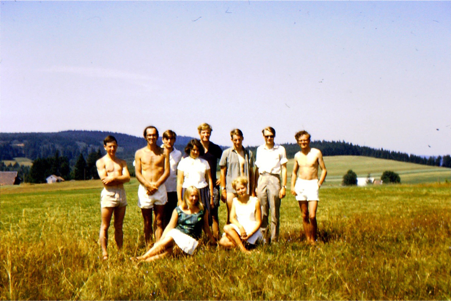
The members of the first 1964 team pictured at the campsite in the Black Forest. Standing from left to right are: Martyn Edelsten, Gordon Edwards, David Beeby, Susan Bennett, Ian Cooper, David Ward, David Thomas, Michael Peel. Seated left to right are Celia Charnings and Victoria Waterton.
I’ve mentioned that we needed vehicles, both to get the staff to Germany and to transport the boys during the course of the camp. CRI supplied these, one of which was a fairly scruffy and aged Bedford van with no seats (apart from driver and co-driver) and no side windows. FD did manage to acquire a pair of brand new windows however and, being 23 years old and believing myself capable of anything, I took the van back to my home in Ipswich where, with the help of my brother, the window apertures were hammered out using a cold chisel and sledge hammer and the windows installed. I also constructed a timber, slatted seat down each side of the van. There were of course no seat belts of any kind. Based on memory, backed up by photographs, I believe the second vehicle was a Commer dormobile/van in somewhat better shape.
With everything seemingly in place, an advance party, myself and three others, set off on July 6th for the Black Forest in the heavily laden Bedford to prepare for the start of the camp on July 13th. The camp site at Plattenhof had a magnificent location high up in the hills of the Black Forest and at the head of a grassy stretch, backed by forest, running down to a small lake next to a farmhouse and gasthaus owned by the jovial Stefan Saum, who lived there with his mother, wife and daughter, all called Maria. (Stefan always referred to me as der Gordan). The preparation entailed erecting eight standard 160lb army tents, a marquee, sundry tables and benches (all deposited by the BAOR) as well as arranging the cooking equipment and, most importantly, digging the male and female latrine pits for the army 3-seater, wooden latrines, which were strategically located among the bushes.
A few days later, the remaining team members arrived in the second vehicle and on the 13th the vans set out to pick up the boys from around Wiesbaden and Frankfurt, either from the Vorderberg refugee camp or from flats. This was a significant round trip of over 300 miles and only at 10 pm did 22 excited boys arrive in camp. After the allocation of tents and sleeping bags etc. they were eventually settled in bed at around midnight and peace descended on the camp and the tired staff. But not for long, as at 4am the boys were apparently up and by the time we had cottoned on to the activity many of them had already been swimming in the lake. Luckily, no one was injured but the incident does demonstrate the downside of just good intentions coupled with amateurism, as an experienced crew would have realised the danger and taken precautions. Mea culpa I’m afraid.
After a few days of adaptation, a regular pattern was established. We usually rose at 7 am and after inducing everyone to wash in a trough of fiendishly cold water, breakfast followed at around 8:30. The weather was hot and a van had broken down, so much of the time in the first week was spent in or around the lake, keeping cool. During the evenings, games such as football and hockey were played. The latter was taken up by the boys with great and almost lethal enthusiasm. The day ended with hot drinks and everybody in bed by 9:45 if possible.
The necessary, everyday tasks were also organised. A washing up routine (not popular) was established, potato peelers were press-ganged into service and unpasteurised milk was fetched each morning from a local farm. The cooking was done using army gas stoves or open fires and involved miracles of ingenuity on the part of the cooks: Celia, Victoria and Sue. (The year being 1964, there was probably an implicit assumption by everybody that cooking was largely a female task!) A regular feature was David Ward’s evening surgery which was very popular with the boys, even if one suspects they had no real medical problem.
One initial difficulty had been to get the boys to keep their tents tidy, and so a competition was started with prizes for the best kept tent. This was taken up with great enthusiasm, to the point where boys were suspected of dropping litter around competing tents. It ended up of course with everybody getting a prize.
Other camp activities included trips in the vans to local points of interest, an obstacle course in the woods, hare and hounds, a treasure hunt and walks in the local area, the last being the least popular. Several times we had campfires in the evening and everybody was expected to chip in with the singing of English and German songs. On the final evening, a party was held in Stefan’s gasthaus, with most of the food being kindly prepared by Frau Saum. After a gargantuan meal, the evening became lively and various impromptu sketches were performed by the boys and the team. Finally we all retired to bed and the next day all the boys, clutching various souvenirs, were returned to their homes.
My report following the camp states that, in my opinion, it was a great success. Some boys didn’t want to go home and all must have benefited, at the very least, from the exercise and the food.
The second 1964 camp
As the first camp finished, members of the second team led by John Rignall arrived and started preparations for their camp. I have no significant memories of this camp as I spent the two weeks of its duration holidaying in Italy. Indeed I have only selective memories of my own camp. However, while doing research on this history I discovered that Edinburgh University also ran some camps at around the same time under the auspices of CRI and then started its own version of CHV that is still active today. In addition, they have an archive of documents for the past fifty years that, amazingly, includes the reports on the camps that John Rignall and I wrote for CRI immediately after the camp. These can be viewed here and lists the team members of the second camp as
- John Rignall – St. John’s
- John Colquhoun – Trinity
- Edward Tozer – Trinity
- Susan Willmott – Girton
- Robin Horsley – Trinity
- John Endacott – St Catherine’s
- Paul Hawksworth – Pembroke
- Lindsay Smith – Girton
- Christine Green – Girton
- Edwards Lyttelton – Kings
- Gill Perry Keene – University College London
- Martyn Edelsten – Edinburgh University
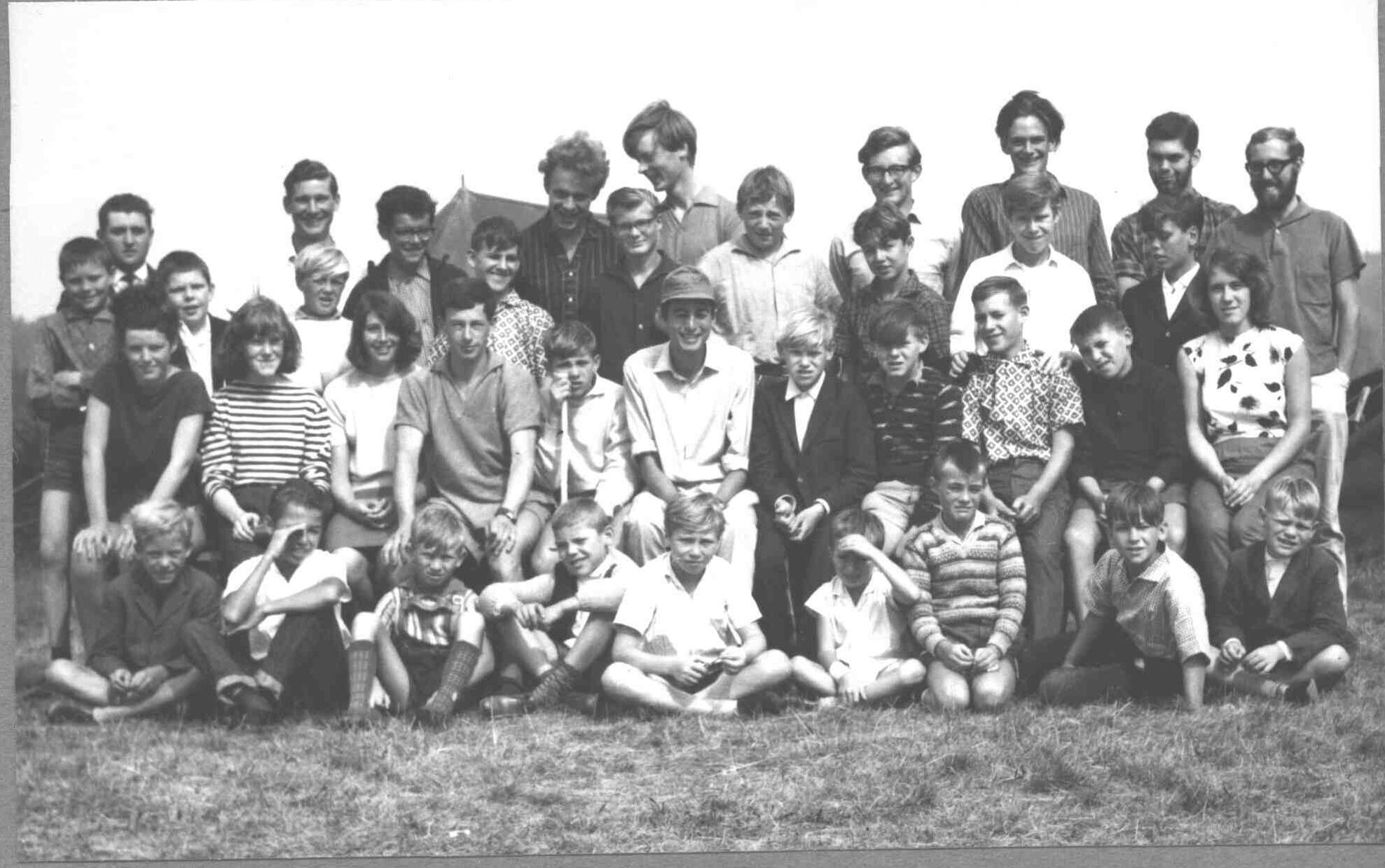
Staff and boys on the 2nd 1964 camp. Back row left to right: ?, EdwardTozer(?), Mike Peel, Edward Lyttelton(?), ?, John Colquhoun, Robin Horsley(?), Paul Hawksworth, John Endacott. Middle row Gill Perry Keene, Lindsay Smith, Susan Wilmott, Martyn Edelsten, John Rignall, Christine Green. (There is some uncertainty associating names with faces!)
The 1965 camps
In 1964 I left Cambridge to do a D.Phil. at Sussex University. However, I was back in the Black Forest for at least one of the 1965 camps, run by David Beeby, as proven by photographs, although my memories of that particular year are faint. Based on the photographic evidence I travelled to Germany in a dormobile with five others, but the only part of the trip that I can recollect, and quite clearly, is visiting the mysterious Domrémy in France, the birth place of Joan of Arc. Another memory is picking up the morning milk a few times with Lynette Gill. This was complicated by the presentation by the family of pieces of speck, fatty smoked bacon, that Lynette detested. However, presuming this to be an honour and not being willing to offend, Lynette somehow managed to secrete the fatty items about her person. I also do remember that at the end of the camp I took off to go walking for a week in the Black Forest, eventually picking up a train for London at Strasbourg.
The year 2014 was the 50th anniversary of the 1964 camp and it was the realisation of this that triggered an effort on my part to document that far-away event and to celebrate and be amazed at what we did, despite our inexperience. Today, we would be inundated with health and safety documentation, police checks, driving checks and all the other paraphernalia of modern enterprises before being allowed to take charge of a group of young boys for a two week camping holiday. I understand the good reasons for this, while simultaneously feeling nostalgic for a time when there were very limited rules and we were at liberty to do pretty much as we wished. Perhaps, though, I’m just feeling nostalgic for my youth.
 Children's Holiday Venture Archive