By John Grundy
When an older undergraduate walked into my freshman room at Clare early in 1966 and said, “You are studying German, John. Would you like to work in Austria next summer?”, I didn’t immediately realise that he was changing the direction of my life. An instinctive “Yes” (I’d worked in Austria before and loved it) led to a major social commitment in my undergraduate years and beyond, and to six summers with long weeks spent in Austria’s Tauern mountains surrounded by young Hungarians and other eastern Europeans.
Writing in 2016 it is difficult to disentangle the word “refugee” from big political issues around migration, terrorism, international upheaval, threats to western Europe’s way of life. Twenty years after the end of World War 2 Europeans were accustomed to refugees as people from a different but not alien culture displaced by the awfulness of war, deserving of help to be resettled wherever the tide of war had washed them up. There was, it is true, a political element to the understanding of refugees in a divided Europe: the mainstream view was that the persons displaced westwards from behind the Iron Curtain were victims of communist oppression. In 1945 the great movements of people were driven by escape from conflict. In subsequent years the desire to move from one political system to another took over. For example, after the failed Hungarian uprising in 1956 Austria in particular, with its strong historical links, received thousands of Hungarians who managed to escape. It was the children of these people that I got to know on CHV’s Austrian camps between 1966 and 1971.
My interest in the lives of refugees had first been aroused when I was at school and in World Refugee Year 1959/60 had been asked to work on a school fundraising committee. Incidentally, CHV also had its roots in World Refugee Year. So when in 1966 Peter Scott suggested work in Austria during my first Cambridge long vacation and said that it involved refugees, I was hooked. I don’t remember my first visit to Overstream House, CRI/CHV’s headquarters on the banks of the Cam, but pretty soon I was learning about the parent charity Children’s Relief International, getting to know the charismatic FD (Bernard Faithfull-Davies), and meeting the other undergraduates who ran Children’s Holiday Venture. CHV’s focus was on providing holidays for European refugee children in Germany and Austria, but CRI had a wider remit involving, for example, resettling the children of displaced persons in the UK, and working with Tibetan refugees in Nepal. For me the chance to work with children – I wanted to be a teacher, so it was useful experience – combined with extending my German language in practical ways as an antidote to Goethe, Schiller and Thomas Mann was doubly appealing. As it turned out, struggling to understand the dialect of an irate Austrian farmer who to our surprise really was saying, “Someone from your camp has been sexually assaulting my heifers”, took me well beyond the Cambridge Tripos in Modern and Medieval Languages!
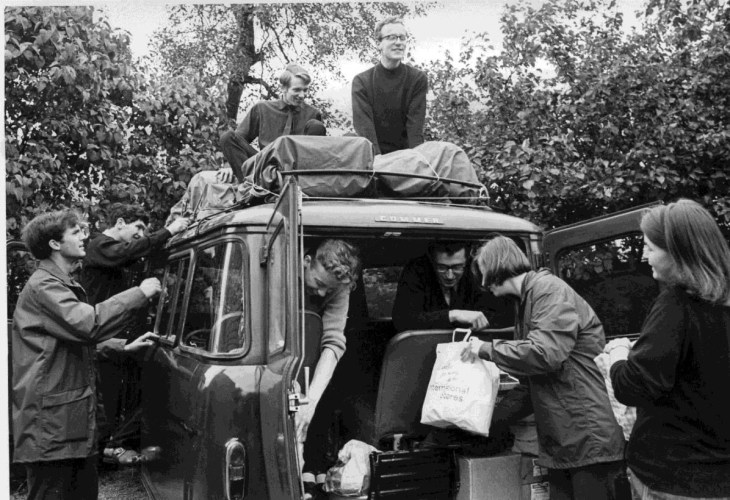
Packing the van, Overstream House, July 1966. Team leader Chris Ingham in the van with glasses, Peter Scott on the roof with glasses, the author at left
There were two distinct annual phases to working for CHV. The bulk of the year, spent in Cambridge or at home, was taken up with fundraising and preparation for the camps. The undergraduates were responsible for raising enough money to run several summer camps at St. Peter in the Black Forest and Weisspriach in Land Salzburg, no mean feat of fundraising and logistics. In 1967 there were six camps catering for 200 children. I can recall sending out thousands of letters to alumni of Clare, St. Catharine’s and other colleges, from whom we received generous support, and organising fundraising events ranging from selling spring flowers in the village shop at home to organising a display and collection at the Cambridge cinema that was showing ‘The Sound of Music’, working on the Austrian connection. We had sponsorship from local suppliers, with the Co-op donating food supplies, and FD’s connections led to BAOR (the British Army on the Rhine) providing tents and NAAFI goods for the German camps. Jakob Meindl’s grocery chain in Salzburg gave us generous discounts on food for the camps there. There was goodwill everywhere: unlike today refugees were not perceived in Britain as a threat, although perceptions in the countries where they lived may have been different. Anyway, with a lot of effort things fell into place and by the summer of 1966 the first group I was involved in, a motley collection of idealistic young men and women, set off from Overstream House in two slightly unreliable Commer and Bedford vans to drive across Germany to Salzburg.
What about the logistics? How could Cambridge students populate their camps with young people? There were two contact points in Austria, the Catholic relief agency Caritas, represented in Salzburg by the redoubtable Anni Ager, and the Protestant Evangelisches Hilfswerk in Vienna. In both cities there were resettlement areas where refugee families were housed, mostly Hungarian but with other nations represented, e.g. Russia, Yugoslavia, Romania, Poland. CHV depended on Anni and her colleagues from Evangelisches Hilfswerk to provide the lists of those children who were to take part in the camps. Local contact in Weisspriach came through the family of Count Palffy, an ancient Austrian noble family now living in what had been their rural hunting lodge. (Wikipedia says about their former residence in Vienna: “Palais Palffy is a palace located on Josefsplatz in the inner city district of Vienna. It was once owned by the noble Palffy family. Today, the building is used for music performances and various kinds of public functions.”) Countess Palffy smoothed the path of relationships with the locals for us. She corresponded with the Cambridge office in good English but caused much mirth one winter when she wrote describing the scene in her valley when they were cut off by deep snowdrifts until the council sent a “bugger” to clear the snow. (She meant “Bagger”, the German word for JCB).
In retrospect an enormous amount of trust was involved, mostly from the families entrusting their children for up to three weeks to some rather naïve students from hundreds of miles away whom they had never met. We had no certificates or qualifications with which to convince people that we were worthy of that trust. I do remember doing a basic first aid course, and in later years each minibus driver did a BSM test on the streets of Cambridge, but otherwise we relied on British creativity, inventiveness and public spirit to see us through. I can see now, but did not realise fully then, the culture shock the children must have experienced coming out of a small flat in a Hungarian enclave in Vienna or a UNHCR building in Salzburg and being taken to a tented camp in a remote mountain valley to be looked after by well-meaning ‘Uncles’ and ‘Aunts’ who knew very little about their background. Culture shock? I wonder if those children, now in their early 60s, remember the evening when a small group of singers from Trinity College passed through the camp and sang them English madrigals under the bright stars of the mountain night.
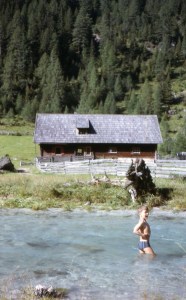
Herr Gahr’s hut, the base for CHV Austria up to 1968
It rains a lot in the mountains of Land Salzburg in July and August. In between there are days of brilliant sunshine and dazzling blue skies. The campsite used in my first three years of CHV consisted of an Almhütte (mountain pasture hut) rented from local farmer Herr Gahr, which lay beyond a basic wooden bridge across the fast flowing stream, and a large hay meadow before the bridge and next to the dirt track up the valley. Staff slept in the hut, the children in tents in the field. After heavy rain the torrent swelled and there was a real danger of field and hut being cut off from each other. The day started with the milk run, when one of the student drivers would take a van down the valley to a pre-arranged point where churns of fresh milk were left for us. Meanwhile others prepared cereal, bread and jam, and breakfast began with the arrival of the milk. Washing up, tidying, fetching firewood and water took an hour or so after breakfast. The daily shopping expedition into Mariapfarr (10 miles away) was oversubscribed with children eager for the trip. Others would play games at the camp, football always popular. Lunch consisted of rolls filled with sausage, fish, cheese or jam, followed by fruit and a soft drink (soup or a hot drink on cold or wet days). In the afternoon we went to the open air baths in Mariapfarr, walked, played games near the camp or, occasionally, went to the cinema. Preparation for the main 7 o’clock meal began at about 4, a meal with soup, a main course, pudding, fruit, biscuits.
During the day we had many activities. Football was by far the most popular, then obstacle courses, initiative exercises, swimming, racing lilos down the stream, and games evolved by the children. (20th century Health and safety would be horrified by the lack of risk assessments!) Given a period of settled weather smaller groups of older children were taken on two-day hikes into the mountains, staying overnight at the Austrian Alpine Club’s Ignaz-Mattis-Hütte at Giglachsee, certainly an experience way beyond the normal range of those urban children. They loved the challenge.
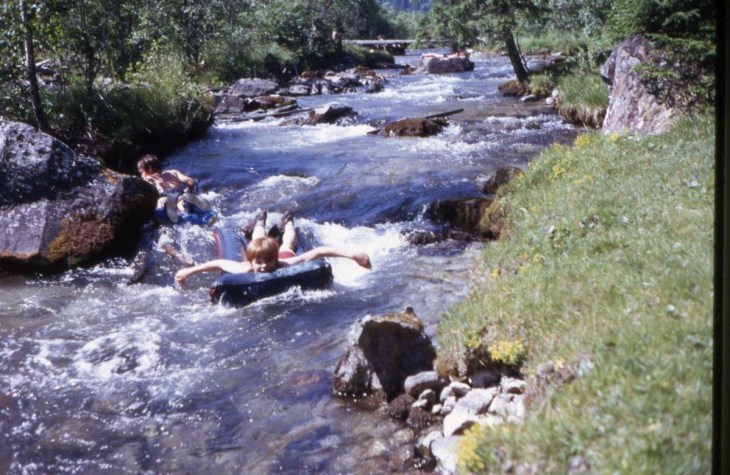
Lilo racing was always a hit
The 30 or so children were normally split into three groups, and at any given moment two of these would be based at the main camp while the other was spending a week in a smaller camp lower down the valley. This enabled the student organisers to get to know the children better and to respond to them individually. Rainy days stretched the ingenuity of the students to the limit, but the youngsters often came into their own when we needed to improvise. One boy of 13 set himself up as ringmaster and produced a remarkable display of circus talent. The same boy also organised a singing competition in which everyone had to take part and was awarded prizes. Since many of the children spoke German only as a second language to Hungarian, Czech, Russian or Ukrainian, the result was a sort of eastern European bloc Eurovision song contest.
In 1968, while students in Paris burnt the barricades in moves towards world revolution and disgust at the Vietnam war, I prepared my third CHV summer, this time as leader of one of the two Austrian groups. My report on the individual children on that camp reflected the concerns that were beginning to grow in some quarters about the relative needs and deprivation levels of some of the refugee children. In Cambridge discussion among students had begun to ask whether it might be more appropriate to direct help towards the deprived of Britain’s inner cities. Some thought that rising material well-being witnessed in a minority of the children meant that they were not suitable candidates for this summer treat. About one boy I wrote, “He wore the same watch as the team leader (only in gold and automatic) and was handing cigarettes round before the train left Vienna.” Nowadays I think we have a clearer perception that deprivation can be measured not only in terms of material things but also emotional stability and psychological experience. My own view was that such boys as Franz, who at 16 was older than most participants and was one of a group known to us as ‘The Big Four’, older boys with a tendency to theft, deception and bullying, could benefit from the stable relationships offered by the CHV experience just as much as the more materially deprived younger children. Others in Cambridge took a different view, and it was around this time that some began, honourably, to shift their emphasis towards relief work in the UK, which I know is continued today by students in Edinburgh.
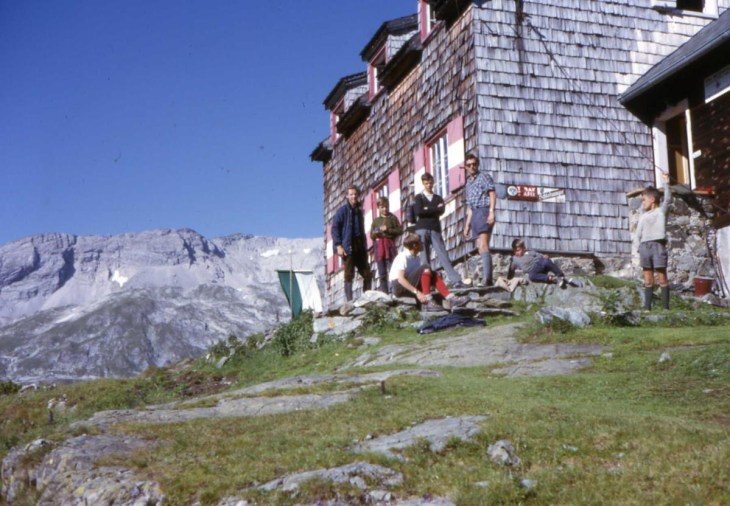
At Ignaz-Mattis-Hütte, Austrian Alpine Club, for an overnight stay
It would be wrong to pretend that every camp was a bed of roses: there were disputes, bullying and quarrels among the children’s nationality groups, there were incidents of theft and damage (I remember apologetically having to return the contents of a collection box to the church in Mariapfarr), there were accidents which led us to a more than passing acquaintance with the local doctor and hospital. But I have no doubt overall of the positive good that resulted from CHV’s efforts for many hundreds of young people in Germany, Austria and later in the UK.
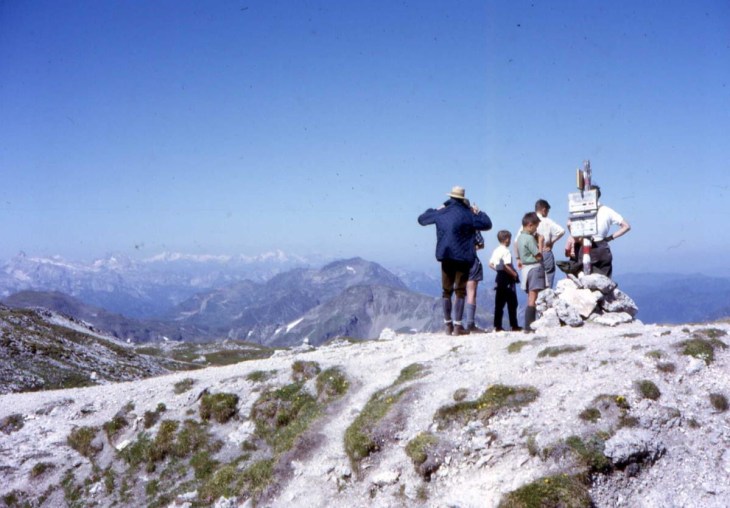
On the Steierische Kalkspitze looking at the Tauern mountains
My personal experience of CHV camps continued through 1969 after I began my career as a teacher, when I spent part of my summer holidays helping out. I accompanied FD as driver on a tour of the camps in Germany, Austria and Yorkshire, for that was the year in which CHV ran its first camp in England in successful collaboration with the army in Catterick. In the following two summers I made brief visits to the camp in Weisspriach, now housed lower down the valley in a more solid farm building, and enjoyed all the fun of working with the children in those brilliant surroundings and loving the overnight hikes into the mountains without having the responsibility of being a full time ‘Onkel’. CHV was evolving in those years. Not only did camps begin in England with English children, but at St Peter in the Black Forest German university students got cheerfully involved in 1969, with CRI/CHV thinking that the way forward was for them to take on the running of the camps in their own country. Sadly, for a number of reasons, that development did not continue. In Austria meanwhile there was an attempt through the Innere Mission charity to start concentrating on the children of the Czech families who had fled their country after the failed Prague Spring uprising of 1968, but again I do not think that it made much progress.
I wrote at the beginning that Peter Scott’s entry into my undergraduate room in 1966 changed the direction of my life. The benefits to me of those years working with CRI/CHV were innumerable: the opportunity to gain experience in planning, fundraising, organising; the responsibility for young lives which took me way beyond the cosy world of a Cambridge freshman; the chance to improve my German language skills in practical ways; an introduction to the history, sociology and geography of central Europe that has been extremely useful later in my career; and perhaps above all the experience of working closely with young people that provided a brilliant platform for my early years as a teacher. Today, working in retirement as a Tour Manager for a travel company, I often visit Austria. The experiences and memories from 50 years ago enable me to see much deeper than the glossy tourist images that I share with my customers.
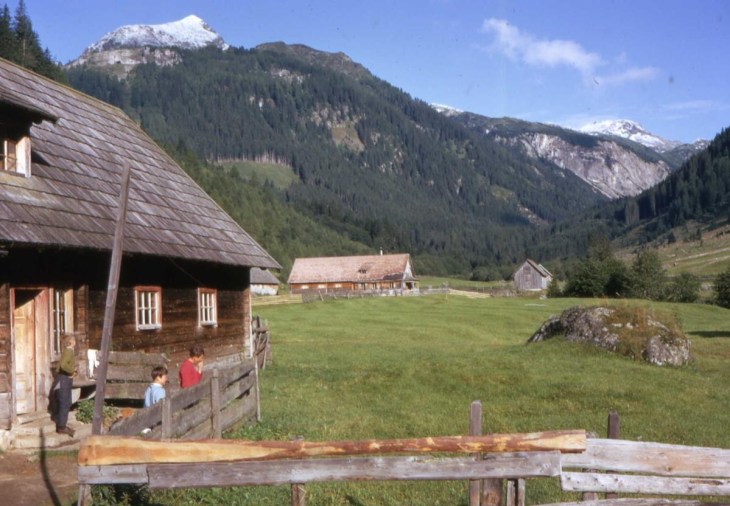
View from the hut up the Weisspriach valley
I have in my possession contemporary reports written about the camps, some personal memoirs, an article about CHV from the Times Educational Supplement in August 1965, and a stack of photographs. All reflect the dedication and commitment of the English students who gave up their vacation time (and the chance to earn holiday money) to throw themselves into this adventure, and the enormous benefits accruing to the children. Decades before student loans, we were a generation lucky enough to be able to ignore that paid summer employment. The personal development was incalculable.
 Children's Holiday Venture Archive